
The Conversation That Changed the Question Alberta

Today, I had one of those conversations with my oldest son that stuck with me long after we hung up. So much so, here I am writing about it.
I expected us to debate immigration.
Instead, he made me question what kind of society we’re becoming.
My son, oldest of 6 kids, and I never land on the same side of political issues. He’s more old-school conservative than I am. I’m more likely to ask uncomfortable questions about power, accountability, and the unintended consequences of public policy, knowing when rights are taken, it is often not our own at first.
We both know this about each other, yet we still sit down and talk... even when those conversations can get a little strained (and they often do, to the point, over the last few years, it has become almost impossible for us to have a normal conversation.)
This time, however, when the conversation inevitably turned to immigration. He said something that stopped me.
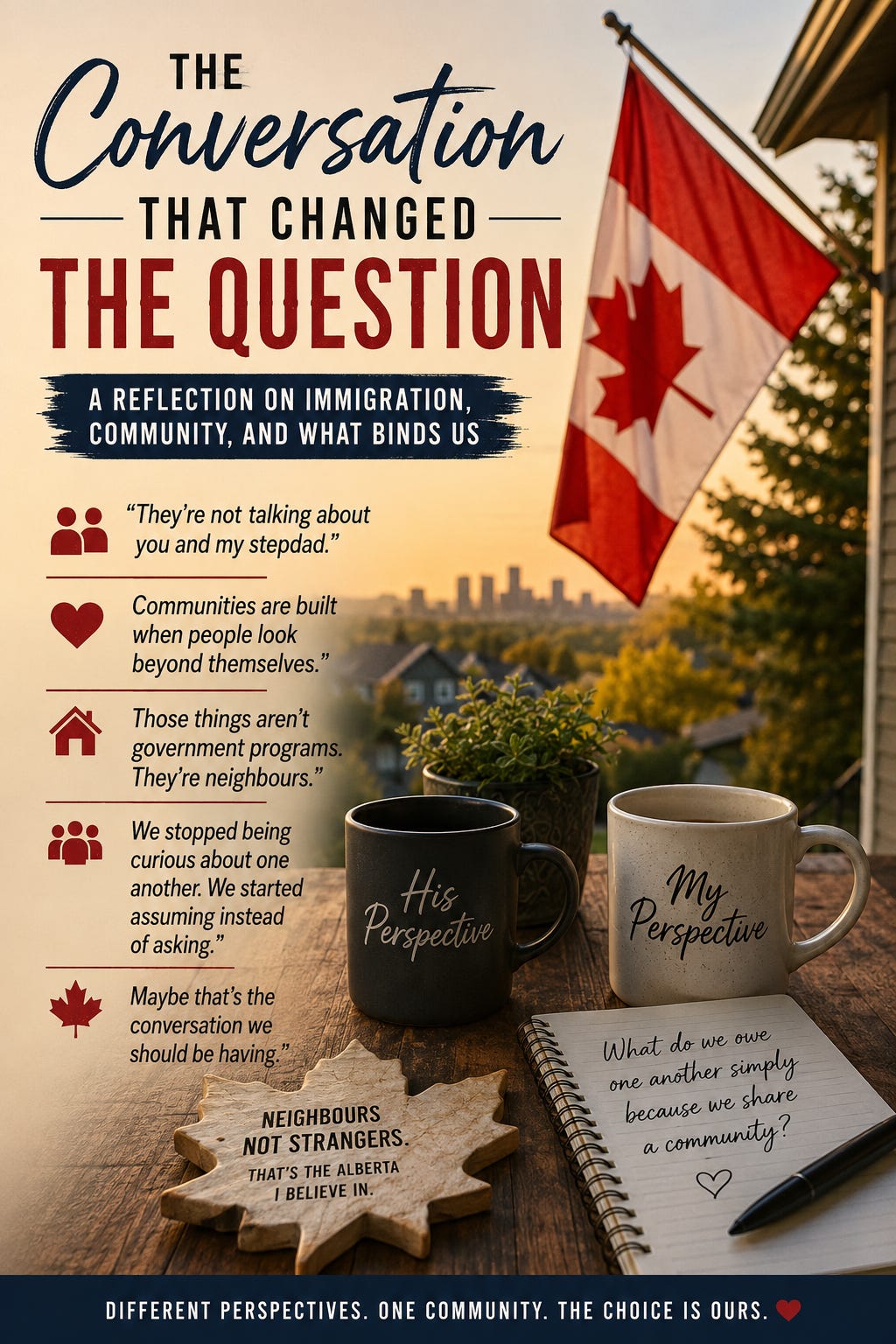
“Mom, they’re not talking about you and my stepdad.”
I knew exactly what he meant.
He wasn’t talking about legal immigrants. He wasn’t talking about people who have built their lives here, paid taxes, raised families, and followed the rules. (As a matter of fact, he jokingly calls me a “Karen” because I’m such a rule follower, most of the time.)
He meant people who enter the country illegally and, in his view, bring the problems they left behind with them.
I told him I understood where he was coming from… but then I asked him to see it from where I am sitting.
My husband is an immigrant from Iraq. He became a Canadian citizen more than twenty years ago.
Most people don’t know his story when they look at him. They don’t know what he believes. They don’t know he served in the military or the things he did that most people would consider heroic. They don’t know he’s worked hard his entire life, raised a family, contributed to his community, and proudly chose Canada as his home.
What they see is a brown-skinned man.
Sometimes that’s enough for some people to decide who he is before he ever opens his mouth.
We’ve been driving through both of Alberta’s major cities and had people drive past pretending to shoot us with their fingers. We’ve had similar things happen in small towns here in Alberta too.
Those people didn’t know anything about him.
They only knew what they assumed.
As for me, I’ve lived in Alberta since 1994. I’ve worked here. I’ve raised my children here. I’ve survived cancer here... three times. I’ve paid taxes here. And I’m a legal permanent resident working toward Canadian citizenship.
I’ve also been the illegal immigrant that so many people talk about. It wasn't something I was proud of, but it gave me firsthand experience with how the immigration system actually works.
The difference is that I’m white, American-born, and I don’t look like what many people picture when they hear the word “immigrant.”
Because I’ve lived both sides of the immigration system, I understand more of it than many people realize and what you can and cannot do.
I know the documentation required to access healthcare.
I know what you need to enroll your children in school.
I know what identification is required to receive government services (which I was never allowed to access, because I didn’t have the ID’s needed). Hell, you can’t even open a bank account in Canada without proving who you are.
That’s why I often struggle when people make sweeping statements about immigration. The reality is far more complicated than many realize.
Policies don’t exist in a vacuum. Governments write them. People live them.
Even when they aren’t intended to affect people like us, they can still influence how people see us.
That’s the difference between intent and impact.
Then my son said something else that got me thinking.
“People just need to focus on themselves.”
I don’t think he realized it, but that sentence changed the entire conversation. We weren’t really talking about immigration anymore. We were talking about two completely different visions of society.
One believes our primary responsibility is ourselves.
Work hard. Pay your bills. Stay out of everyone else’s business.
I see it differently. I believe communities are built when people look beyond themselves.
That neighbours matter. That empathy isn’t weakness but rather It’s the glue that holds a society together.
Neither philosophy starts from a bad place.
One values independence.
The other values interdependence.
But they lead us to very different places.
For me, if we only ever focus on ourselves...
Who checks on the elderly neighbour whose family lives halfway across the country?
Who brings meals to someone recovering from surgery?
Who coaches kids’ sports after working all day?
Who volunteers at the food bank?
Who stands beside a friend going through cancer?
Who helps the family that just lost everything in a fire?
Those things aren’t government programs.
They’re the neighbour who notices your driveway hasn’t been shoveled.
They’re the friend who quietly drops supper on your doorstep.
They’re the stranger who stops to help when your car breaks down.
They’re community.
They’re the quiet moments where someone decides another person’s wellbeing matters too… And that is the Alberta I have known and loved for over 30 years.
Over the past year, I’ve written about governments, legislation, and accountability, but this conversation reminded me of something even more important.
Politics doesn’t begin in Parliament.
It doesn’t begin at the Alberta Legislature.
It begins around kitchen tables.
It begins when families can ask difficult questions without feeling like one of them has to “win.” It begins when we’re willing to respect one another enough to listen before we respond.
My son didn’t change my mind.
I don’t think I changed his either.
But he did change the question.
Maybe the real question isn’t whether we’re too tough or too soft on immigration.
Maybe it’s this:
What do we owe one another simply because we share a community?
When we look at someone’s skin colour and decide who they are...
When we judge someone because of their religion...
Their accent...
Their sexual orientation...
Or simply because they were born somewhere else...
We’ve already created an “us” and a “them.”
And personally, I think that’s exactly where societies begin to fracture, as we are currently seeing in Alberta.
Many of my readers know I grew up in Oklahoma. I was raised in a family of Reagan Republicans. Oil and gas wasn’t just an industry … it was our family business. I attended excellent schools, schools that were considered among the best in the United States at the time.
Yet despite growing up in Tulsa, I was never taught about Black Wall Street. I was never taught about the Tulsa Race Massacre. No, I didn’t learn about it until my own children were being taught about it here in Canada.
That realization has stayed with me for years, because it reminded me how easy it is to make assumptions when we only know part of the story.
The same thing is happening now.
Unless we take the time to know someone, we’ll fill in the blanks ourselves.
My husband has lived a life most people know nothing about. He’s seen parts of the world many of us couldn’t imagine. He’s experienced things that would break some people. Yet instead of allowing those experiences to fill him with bitterness, he chose to build a happy life here.
He chose Canada.
He became a citizen.
He proudly flies the Canadian flag outside our home.
He loves this country deeply.
In fact, I’d argue he’s prouder to be Canadian than many people who happened to be born here.
And yet for some people...He’ll never be Canadian enough.
Not because of the life he’s lived.
Not because of the values he holds.
Not because of the contributions he’s made.
Simply because of what they see before they’ve taken five minutes to know him.
And to me...
That’s the real tragedy.
Not that people disagree about immigration. Healthy democracies need those conversations.
The tragedy is that we’ve become so quick to judge strangers that we’ve forgotten how to become neighbours. Somewhere along the way, we stopped being curious about one another.
We started assuming instead of asking.
We started choosing teams instead of choosing community.
And Alberta, the one thing I do know is this…
The Alberta I fell in love with wasn’t built by people who only looked after themselves.
It was built by neighbours and community.
Maybe that’s the conversation we should be having. Tell me what you think in the comments. Am I wrong? Let’s talk about it, respectfully.
Now is the time where I ask for support. Through my paid subscribers, I am able to keep this publication free for everyone. Most of the time, I write about policy in Alberta, the effects it is having and connecting the dots on where they actually come from.
I am passionate about this, because I am living with the consequences, as are so many others. So, if you find value in my writing, please consider becoming a paid subscriber. My free subscribers are also very important, because without them, the algorithms would not even pick up my work. Thank you guys for helping me spread my words near and far.
As always, in a world full of hate and division, the only way we will make it out of this in one piece is to remember kindness to one another. Empathy. And, true patriotism.
Thanks Guys, and I hope you have a wonderful day!! Enjoy the heat we are FINALLY having. Bye!
I loved your piece, Linda. Alberta is not what it once was. COVID taught me how incredibly selfish a large portion of the province is. Maybe it was always that way but COVID shone a spotlight on it. When adults willingly choose to not care for seniors, immuno-compromised, children, those more vulnerable through no fault of their own, that is 100% selfish. The provincial government plays a huge part in this attitude of me, me, me. Albertan’s who have not opened their eyes yet are going to learn PDQ (pretty damn quick) that it is getting even worse than me, me, me …. it is now industry, industry, industry over human beings at whatever cost.
Yes! Yes! Yes Bill!!! 100%